Sunday, September 30, 2012

Death Valley - Racetrack Playa

The Amazing Sliding Rocks

Welcome to the Racetrack Playa at Death Valley National Park, home to a most peculiar natural phenomenon - rocks that apparently move around by themselves.

The flat, clay-like surface of the playa was once the bottom of a mountain lake.  Rocks tumble from the surrounding slopes onto the playa as a result of common erosion. But here is where the mystery begins - the rocks continue to move along the level surface of the playa.

Mysterious Sliding Rocks!


Pebbles will slide across the playa with the slightest breeze. But much larger stones - some the size of a microwave over and weighing hundreds of pounds - will move under certain conditions. Even more surprisingly, the rocks leave behind mysterious trails that mark the direction and distance of their travels.


a photo of a sliding rock at the racetrack in death valley
Rocks Fall From The Mountains...And Keep Going!


Trails in the playa can be up to a mile in length, but no one has ever seen any of the larger rocks move.

a photo of long trails left by sliding rocks on the racetrack in death valley
Long Trails, Racetrack Playa, Death Valley NP


What's the secret?  How do rocks move unassisted along a level surface?

In rainy weather, the playa becomes soft and slippery.  Visitors are asked not to walk on the playa when it's wet, because the impressions left by their footprints can last for years. (Unfortunately, some visitors fail to follow these guidelines.) This explains how the moving rocks leave an impression in a normally rigid surface.

Does the moistened playa become slippery enough to allow the wind to push heavy rocks across its surface?  No one knows for certain, but this would seem to be the most reasonable explanation.  The surrounding mountains form a channel where wind is accelerated.


a photo of a rock making a curved path at the racetrack in death valley
Ha ha! I bet you didn't see me move!

Would you like to explore the Racetrack Playa for yourself?  Some preparation will be required.  Firstly, as with most of Death Valley, exploration in the summer months is strongly discouraged.  The heat is extremely dangerous, and distances are significant.  It can take a long time for help to reach a stranded hiker or motorist.  Perhaps too long.

Secondly, you'll need a sturdy vehicle.  To reach the Racetrack Playa you'll need to drive thirty-plus miles on one of the roughest washboard roads I've ever encountered.  The rocks on this road will quickly shred the tires on your rental car.  Your best bet is to rent a Jeep with the right kind of tires.


a photo of photographer daniel south at the racetrack playa in death valley national park
I Could Go For A Nice Hot Shower About Now

I need to add a cautionary note here.  Keep your camera, lenses, phone, tripod, water bottles, food containers, and all other supplies in tightly closed bags while driving along the washboard roads.  The dust in this area adheres to everything, and your vehicle will kick up a lot of dust.  It stuck to my water bottles as though it had been glued on.  Don't expose your valuables and your tech gadgets.  Keep them in cases, and wrap the cases up in heavy garbage bags.

After 26 miles of pounding washboard, you'll arrive at a curiously decorated sign post known as Teakettle Junction.  Only six more miles to the playa, but it's the roughest part of the trip.

a photo of teakettle junction in death valley by daniel south
I Wonder Why They Call It Teakettle Junction


There are no comfort facilities at the Racetrack, but there's a campsite a few miles down the road.  There, you'll find a lone portable toilet which I've fondly nicknamed 'The Outhouse of Last Resort'.  You would be well advised to bring along your own supply of toilet paper and hand sanitizer.
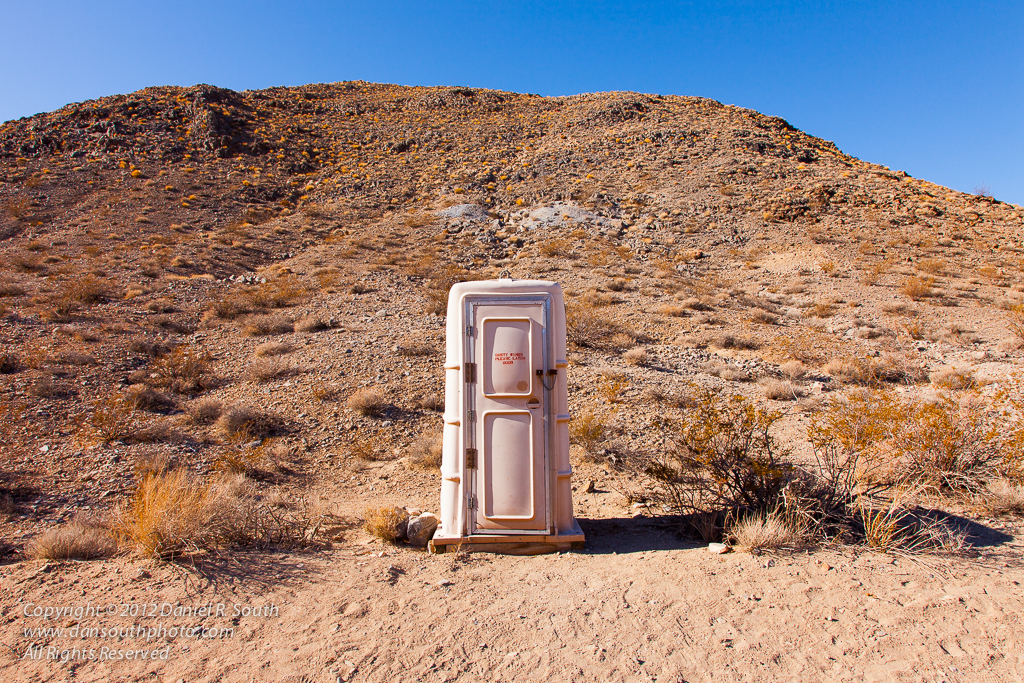
a photo of an outhouse in death valley
The Outhouse of Last Resort


If everything goes well you can enjoy one of the world's great mysteries, grab a number of memorable shots, and look forward to another long drive on washboard roads, all in a day's adventure.


a photograph of a brilliant sunset at the racetrack in death valley
Racetrack Playa at Sunset, Death Valley National Park


Camera:
        Canon EOS 5D Mark II

Lenses:
        Canon 24-105 f/4L IS
        Canon TS-E24 f/3.5L II


Light happens.  Be ready.  Shoot hard.

Copyright © 2012 Daniel R. South
All Rights Reserved

Thursday, August 16, 2012

Death Valley National Park

Some Like It Hot

An advertising consultant might suggest that Death Valley has a branding problem.  That name doesn't sound particularly welcoming.  It doesn't suggest a land of unique and surprising beauty.  And it certainly doesn't sound like much of a vacation destination.

Luckily, labels aren't always accurate.  Scorching summer temperatures notwithstanding, Death Valley National Park is a magnificent and incomparable natural wonder.

Let's explore some of the park's diverse attractions.


Salt Flats near Badwater Basin

Death Valley once contained a lake.  Over time, large mountain ranges were forced upward in the west separating the lake from ocean moisture.  Moisture precipitated onto the towering mountains.  By the time that clouds reached Death Valley, most of their water supply had been exhausted.  The lake eventually dried up, but it left behind an abundance of salts and minerals.

We can still see these salt deposits today.  Surrounded by mountains these 'salt flats' can be visually stunning under the right conditions.

This photo was taken just after dawn as sunlight began to hit the Panamint Mountains to the west.


a photograph of the Badwater Basin Salt Flats at Sunrise in Death Valley
Salt Flats at Sunrise near Badwater Basin, Death Valley

Sunrise at Zabriskie Point

Zabriskie Point is the park's most popular place to watch the sunrise.  The dawning sunlight moves over a complex configuration of badlands and projects an inspiring array of colors and shadows.  Here, a feature known as Manley's Beacon is bathed in the fresh glow of a new day.

a photo of manley's beacon from zabriskie point at sunrise in death valley
Daylight Strikes Manley's Beacon, Zabriskie Point


Natural Diversity

Death Valley is a diverse landscape featuring rugged mountains, wind-swept dunes, and sprawling lava flows.


a photograph of lava flows at death valley national park
Lava Flows, Death Valley National Park

a photograph of the Mesquite Sand Dunes in Death Valley
Mesquite Sand Dunes near Stovepipe Wells, Death Valley


Scotty's Castle

A more unlikely pair would be difficult to imagine.  Wealthy, mild-mannered insurance businessman Albert Johnson befriended entertainer, cowboy, and eccentric story-teller Walter Scott, also known as 'Death Valley Scotty'.  Together the two spent decades building a sprawling vacation residence in Grapevine Canyon at the northern end of Death Valley.

Johnson's money financed the project although 'Scotty' convinced anyone who would listen that the mansion had been funded by his own secret gold mine.

a photo of scotty's castle in death valley national park
Scotty's Castle

The Racetrack

Beyond Grapevine Canyon and the volcanic Ubehebe Crater lies the entrance to an old mining road.  The road has a punishing washboard surface and it not suitable for passenger cars.  If you have a good back, a strong constitution, and a four-wheel-drive vehicle with heavy-duty tires, you can follow this road to one of Planet Earth's most peculiar mysteries - the moving rocks of Racetrack Playa.

No one has ever seen the rocks move, and no one is absolutely sure how it happens, but the rocks move along the clay-like surface (with some help from wind and rain) and leave trails to show the path of their movements.  It is a marvelously fascinating phenomenon.


a photograph of sliding rocks on the racetrack playa in death valley at sunrise
Intersecting Paths, Racetrack Playa

For the photo of the sliding rocks above I began a jolting two-and-a-half hour Jeep ride at 3:30 in the morning, wandered around in darkness looking for the composition, set up and executed the shot in freezing 27-degree (F) weather.  My hands were so numb by the time that I'd finished that I couldn't disassemble the tripod.

But it was worth it.  ;-)

I hope that you have enjoyed these images from Death Valley.  I'll be posting others in the near future, so please feel free to visit again soon.

I'll leave you with one last image, and we'll return to Zabriskie Point for a brilliantly colorful sunset.  This is one of my favorite photos of all time.


a photography of zabriskie point in death valley at sunset
Sunset Over Zabriskie Point, Death Valley National Park

Camera:
        Canon EOS 5D Mark II

Lenses:
        Canon 16-35 f/2.8L II
        Canon 24-105 f/4L IS
        Canon TS-E24 f/3.5L II
        Canon 70-200 f/4L IS


Light happens.  Be ready.  Shoot hard.

Copyright © 2012 Daniel R. South
All Rights Reserved

Thursday, July 19, 2012

Overcoming Obstacles

Pulling Out The Tricks When Conditions Get Tricky


Nobody said that this would be easy.


If you want to accomplish something worthwhile, you're going to encounter some challenges along the way.  You'll need to recognize the most significant obstacles and devise a plan to overcome them.  You also need to stay positive so you can maintain the energy and conviction necessary to get you to your goals.


Good news: we don't need to solve all of the problems at the same time.  We can resolve them in sequence - 'divide and conquer' - as we move toward incrementally better outcomes.


Walking through the park one morning I encountered a group of musicians from Ecuador.  Sometimes I see South American musicians on the street playing flutes over pre-recorded music, but that rarely impresses me.  These gentlemen, on the other hand, were playing all of the parts live, and they sounded really good!


I saw this as an opportunity to take some interesting photos, but there were some hurdles to overcome, i.e. there were some serious technical obstacles to getting good photos in this scenario.


What do you think - are you up for a challenge?  Do you think you could identify the problems in this situation and help me resolve them?  Let's have a look at the conditions to see if we can figure out some ways to improve the quality of our shots.  There's a lot of work to do here; I could definitely use a good assistant.


By the way, I showed some of my initial shots to the musicians.  They gave me nods of approval and asked me to send them copies by email.  I asked whether I could take some additional shots, and they agreed.  I always like to get buy in from my subjects.


Making the introductions wasn't the tricky part.  The challenges in this case were technical and numerous.


So here we go, My Trusty Assistant.  Let's tackle those bothersome obstacles!


Obstacle # 1 - The White Shirts


Our modern, computer-controlled cameras are remarkably stupid devices.  Black, white, and gray all look the same to the camera's light meter.  They can put a man on the moon, but photographers still have to compensate manually for over- and underexposure.


Cameras tend to under-expose scenes that contain a lot of white.  This is why pictures of snow sometimes come out looking gray.  If I had let my camera make the decisions, these photos would have been dark and the faces would have been shadowy and unrecognizable.


Simple Solution - before I shot the musicians I took a photo of the grass.  Grass isn't white or highly reflective.  It has what we call a mid-tone reflectance similar to average gray.  Light meters LOVE mid-tones (they're tuned to average gray), so that's a great place to take an exposure reading.


No, I'm not going to show you the grass photo.  It's just a picture of green grass - nothing exciting - and it served its purpose by making these other photos possible.


Obstacle # 2 - Subject Movement


Musicians move fast.  Well, their hands move fast - really fast.  I didn't want to see blurry fingers on the instruments.  In order to freeze that kind of motion I would need to use a rather fast shutter speed; about 1/1000th of a second would be good.


My initial grass exposure was a little bit slower.  (Watch out!  Here comes the intimidating mathematical portion of the discussion.  Feel free to skip this section if fractions give you a headache.)


Grass exposure: 1/400th of a second @ f/5.6 @ ISO 400


1/400th of a second was about half of the speed that I needed.  In order to boost the shutter speed I would need to trade off in some other area.


I wanted to keep my aperture set to f/5.6 for compositional reasons.  f/4 would have given me more light enabling a faster shutter speed, but the narrow depth of field would have been problematic.


Simple Solution - boost the ISO to 800.  This makes the camera's sensor twice as sensitive to light.  I could now double my shutter speed to 1/800th of a second, which is fast enough to freeze just about any motion that a human body can make, and maintain an equivalent level of exposure.


Final exposure: 1/800th @ f/5.6 @ ISO 800


Nice and fast - no blur!


Obstacle # 3 - Unattractive Lighting


A combination of haze, humidity, and thinly overcast skies created unflattering lighting conditions.  I wanted the musicians to look vibrant, not ashen and sickly.


Simple Solution - we can borrow a technique from our friends in the movie industry.  Replace the light that you have with something better.


For still photographers this usually means adding flash.


It may seem unusual to use flash outdoors during daylight hours, but it's actually very common, and in cases like this, almost unavoidable.


I attached a flash unit to my camera and reset the white balance accordingly to the Flash setting.  I boosted flash compensation to +1.0 so it would overwhelm the natural light falling on the subjects.


Presto!  Warmer light, better colors and skin tones, and fewer shadows - all courtesy of the flash unit.


Obstacle # 4 - Flash and Fast Shutter Speeds


For reasons that I won't get into, flash is typically restricted to a maximum shutter speed of 1/200th of a second.  If you try to use your flash at a higher speed, the camera might not let you do it.  If you force the issue, part of the frame might end up dark; the light from the flash will be blocked the they shutter as it moves across the sensor plane.


That said, I was shooting at 1/800s, remember?  That's four times the normal maximum speed.  How am I getting away with using flash at such high shutter speeds?  Do I have some trick up my sleeve?


The answer is YES, there IS a trick and I'll explain it below.


Simple Solution - The engineering geniuses at Canon, Nikon, Sony, and similar franchises recognized this problem and created an amazing solution that's called ... you going to love this one:


High-Speed Flash Sync Mode


Basically what this mode does is to break the "flash" of light up into a series of very fast pulses.  It still looks like one "flash" to our eyes, but it enables the camera to cover the entire frame with light.


But there are a few caveats to using High-Speed Flash Sync Mode:

  • First, you have to remember to turn it on.
  • Next, you have to figure out how to turn it on.  Luckily, Canon's flash units have a dedicated button that provides immediate access to this function.
  • Finally, you won't find this feature on your smart phone or your point-and-shoot camera.  This is the domain of external flash heads only, and you need to use a flash that's made by the same manufacturer as the camera body - no 'third party' accessories.

If you can get past all of these conditions, High-Speed Flash Sync Mode is a blessing for anyone who needs to add flash to shooting conditions that involve fast shutter speeds.


Obstacle # 5 - Diminutive Subjects


The musicians were rather diminutive, but I didn't want them to LOOK small.  I wanted them to look commanding as though they were up on a stage looking out over the audience.


Simple Solution - crouch down and shoot upward.


Aha!  It works!  Plenty of rock stars and movie stars are short, but they seem larger than life because we're always looking up at them or at least looking them directly in the eye.  We should give our photographic subjects the same courtesy unless there's a compelling reason to photograph them from above.


Such as, for instance, you're a foot taller than they are.  But that could never happen. ;-)


Any worthwhile endeavor will present obstacles.  Don't shy away from the challenge.  Keep a positive perspective and an open mind.  We always have some resources at our disposal. The trick is to apply those resources creatively in order to meet our objectives.


No one said it would be easy, but it's definitely doable.


Camera: Canon EOS 5D Mark III
Lens: 70-200 f/4L IS


Light happens.  Be ready.  Shoot hard.

Copyright © 2012 Daniel R. South
All Rights Reserved

Wednesday, June 20, 2012

The Big Show - Part One

Opening Night Favorites

It was a wonderful opening night.  Spectacular light poured into the gallery from the west.  The layout looked even better than I had imagined it.  Lots of nice folks stopped by to enjoy wine and stimulating conversation.  And if I may say so, the prints looked pretty darned good.

One friend told me that the images looked "sharper than real life."  I was humbled by the compliment.

Everyone had a favorite print - or two, or three, or four - and we had a lot of fun discussing each image and the story behind it.

One of the big hits was The Painted Piano, which I count among my personal favorites.  Beyond the novelty of the scene, the musician's expression is compelling, and the colors are rich and bold.  This is probably the sharpest print in the show, as well, which certainly doesn't hurt.

a photo of a man playing a brightly colored painted piano in new york


Another favorite was Ballerina With Photographers primarily due to its unusual perspective.

a photo of a ballerina being photographed at washington square park


Many folks enjoyed the quirky Free Hugs, which I snapped in Union Square Park - just prior to receiving a hug that I really wasn't prepared for.  One attendee expressed an interest in hanging this in his office.

a photo of people giving away free hugs at union square in new york


Another personal favorite, Cigar Store Indian received a number of compliments.  Folks enjoyed the juxtaposition between the young couple and the carved antique Indian figure.

a photograph of a cigar store indian by daniel south


Finally, The Reader generated quite a bit of excitement as anticipated.  I had received so much positive feedback on this portrait through the blog and the website that I decided to make it the centerpiece of the exhibit, a forty-inch print hanging solo on a dedicated wall. 

a photograph of a young woman reading on the street in new york city


The exhibit will hang for only two more weeks, so if you want to see these works in person, you'd better catch the R train and hop on over to Brooklyn pronto, amigo.


Exclusive engagement through 4 July 2012 at Two Moon Art House and Cafe, 315 Fourth Avenue, Brooklyn, NY.

Gallery inquiries welcome.


Light happens.  Be ready.  Shoot hard.


Copyright © 2012 Daniel R. South
All Rights Reserved

Thursday, June 14, 2012

The Painted Piano

'Summer In New York' - Show Begins This Week!

New York is an unpredictable place. One day you'll walk down the sidewalk and see mostly ordinary, mundane things. On another day you might see a man playing a painted piano in the middle of the street.

Hopefully, you were prepared and remembered to bring your camera with you that day.  


a photo of a piano painted in bright colors in new york city
The Painted Piano


See the entire exhibition at:

315 Fourth Avenue
Brooklyn, New York


Camera: Canon EOS 5D Mark II
Lens: 24-105 f/4L IS


Light happens.  Be ready.  Shoot hard.


Copyright © 2012 Daniel R. South
All Rights Reserved