Showing posts with label Death Valley. Show all posts

Monday, February 3, 2014

Rating Photographs Constructively

Four Views of Death Valley

It's not easy to rate one's work objectively, but there are advantages to be gained from making the effort. If we want to feature our best photos (for clients, for a website or a photo book, for instance), we need to be able to select the best shots from a larger population. The rating process can also help us to identify our own strengths and weaknesses.

Photo editing and organizing software titles usually provide a "rate by stars" feature.  The number of stars indicates a level of quality.  Typically, a five-star rating is considered the best, but one could flip the ratings system and mark with best work with a single star if they wanted to. (Canon users might like this inverted system, since Canon's best cameras are marked with the number 1.)


a photo of the general store at the rhyolite ghost town in nevada by daniel south
Technically competent but not difficult to reproduce. Rating: **


As for what each level of stars means, there are different options.  But before we discuss applying stars to photos, let's compare for reference the way that a movie critic might use the star system to rate upcoming films.

The Movie Critic's Rating System
* - A really bad film. Don't waste your money.
** - Disappointing. If you must watch it, wait until it comes on TV for free.
*** - A good, solid film, but nothing special.
**** - A very good film with few if any flaws. Highly recommended.
***** - An outstanding film. A contender for Best Picture. A must see.

There are good movies and great movies. There are movies that are somewhat disappointing and others that are laughably bad. The Movie Critic's Rating System has to cover all of these bases.


a photograph of impostor rock on the racetrack playa in death valley by daniel south
Exotic locale. Technically challenging (infinite focus). Rating: ***


But when it comes to our own photos, do we need to mark the bad ones with a star? How about just not rate them at all? Does this rating system make sense for a photographer who is sorting through their work?

Photo Rating System Number 1 (From Bad to Great)
* - A bad photograph. I regret that I took it.
** - A disappointing photo. I could have done better.
*** - A good, solid photo, but nothing special.
**** - A very good photo with few if any flaws.
***** - My best work. I'll show it proudly.

I'm sure that lots of people use this method to good effect, but personally, I find that it doesn't offer enough gradation. Why would I bother to tag a bad photo with a star or a disappointing shot with two stars. It's a waste of stars. Just leave them unrated. Further, if ALL of my good photos get four- or five-star ratings, how would I identify my very best work? I've already run out of stars.


Same locale and technique, but adds a unique sky. Rating: ****


Here is the rating system that I have adopted for my own work. It provides several levels of "good" within the five-star range.

Photo Rating System Number 2 (From Good to Better to Outstanding)
* - Good. A better than average photo. An image that caught my eye upon initial review and shows potential that I might want to explore in the future.
** - Better. A solid image with no perceivable flaws. Work that I would feature proudly on my website. (This is the level where viewers start to say "Wow!")
*** - Exceptional. Beyond technical competence. An image that is emotionally stirring or represents special conditions or circumstances that could not be easily repeated.
**** - Outstanding. Perhaps the best image in an entire collection.
***** - Rare. Among my personal best. The type of image that we don't make many of over the course of a year.

This is the system that works for me. It offers the opportunity to classify my work with varying levels of "good" so I can differentiate the rare gems when they come along instead of wasting stars on mistakes and disappointments.

Mundane or flawed images simply don't get any stars. If an image has even a single star it means that I thought highly of it enough to separate it from the pack. Most of the images that I display publicly are ** or ***, because four- and five-star ratings are reserved for rare and exceptional work. 


a photo of zabriskie point at sunset by daniel south
Technically challenging (exposure). Once in a lifetime sunset. Rating: *****


What are the pros and cons of the rating system that you use? Do you use stars at all, or do you use another rating system (colors, flags, keywords)? How well does your system work for you?


Camera:

        Canon EOS 5D Mark II

Lenses:
        Canon EF 16-35mm f/2.8L II
        Canon TS-E24mm f/3.5L II
        Canon EF 70-200mm f/4L


Light happens.  Be ready.  Shoot hard.

Copyright © 2014 Daniel R. South
All Rights Reserved


Tuesday, June 4, 2013

Death Valley Sunrise

First Light At Badwater

Good morning!

There are lots of Death Valley Sunrise photos on the Internet.  I suppose that one more couldn't hurt.

Imagine the feel of salt crunching under your feet as you hike out onto the flats in darkness.  The air is silent and surprisingly chilly. You half-seriously wonder whether a pack of coyotes is going to eat you for breakfast.

Now you're in the zone! Enjoy the sunrise!


a photo of the sunrise on the badwater salt flats in death valley
Death Valley Sunrise

This photo is brought to you courtesy of an exotic location, some timely clouds, and Canon's incomparable, ultra-amazing 24mm tilt-shift lens.

Please support our incomparable, ultra-amazing National Park system.  And watch out for hungry coyotes!


Camera:
 Canon EOS 5D Mark II

Lens: Canon TS-E24 f/3.5L II


Light happens.  Be ready.  Shoot hard.

Copyright © 2013 Daniel R. South
All Rights Reserved

Monday, April 15, 2013

Ghost Towns

Boom and Bust in the Old West

Ghost towns are strangely fascinating places.  Idolized in stories about the hardships of the Old West, these communities were deserted by their citizens and left to crumble in the wake of financial collapse or other turns of misfortune.

Times change, promises fade, mines close, wells run dry, and business moves on.  Today, only the shells of buildings remain, bare walls and foundations stripped of lumber, copper, and other valuable materials.


a photograph of the rhyolite ghost town in nevada near death valley national park
General Store, Rhyolite Ghost Town, Nevada

Perhaps the ghost town is the architectural equivalent of an obituary page, a volume of cautionary tales foretelling the demise that awaits those who take foolish risks or rely too heavily on the good graces of providence.

The ghost town is bleak, bankrupt, crumbling, and deserted, yet we still feel compelled have a glance or even spend a few hours exploring their mysteries.

The ghost town represents our fears come true.  We want reassurance that this bitter fate won't happen to us, to our homes, to our towns. 

Rough times hit everyone sooner or later.  No one understands this better than those who have seen ruin and devastation up close.


Camera: Canon EOS 5D Mark II

Lenses: Canon EF 16-35 f/2.8L II


Light happens.  Be ready.  Shoot hard.

Copyright © 2013 Daniel R. South
All Rights Reserved

Sunday, January 13, 2013

Scotty's Castle

Death Valley's Mysterious Mansion

I won't attempt to tell the story of Scotty's Castle.  No one knows all of its secrets, and even the 'facts' are murky.


a photograph of the facade of scotty's castle in death valley national park
Scotty's Castle, Death Valley National Park

The project started as a vacation home for Albert M. Johnson, a millionaire insurance executive with an interest in gold mines, and his associate, Walter E. Scott.  Scott, also known as "Death Valley Scotty," may or may not have convinced Johnson to invest in non-existent gold mines in the California desert.  Johnson didn't seem to hold a grudge, and the two became close friends.  Death Valley Scotty lived in the 'Castle' for the rest of his days.


a photo showing detailed wood carving at scotty's castle
Scotty's Castle, Exterior Detail


a photograph of the interior of scotty's castle in death valley
Scotty's Castle, Interior


a photo showing the detailed tiles at scotty's castle


a photograph of the clock tower at scotty's castle


Scotty's Castle an attraction in Death Valley National Park in California.  The National Park Service provides entertaining and informative tours of the property.  The location is remote, but the tours are suitable for visitors of all ages.


Camera:
        Canon EOS 5D Mark II

Lenses:
        Canon 24-105 f/4L IS
        Canon 70-200 f/4L IS
        Canon 16-35 f/2.8L II
        Canon TS-E24 f/3.5L II

Light happens.  Be ready.  Shoot hard.

Copyright © 2012 Daniel R. South
All Rights Reserved


Sunday, September 30, 2012

Death Valley - Racetrack Playa

The Amazing Sliding Rocks

Welcome to the Racetrack Playa at Death Valley National Park, home to a most peculiar natural phenomenon - rocks that apparently move around by themselves.

The flat, clay-like surface of the playa was once the bottom of a mountain lake.  Rocks tumble from the surrounding slopes onto the playa as a result of common erosion. But here is where the mystery begins - the rocks continue to move along the level surface of the playa.

Mysterious Sliding Rocks!


Pebbles will slide across the playa with the slightest breeze. But much larger stones - some the size of a microwave over and weighing hundreds of pounds - will move under certain conditions. Even more surprisingly, the rocks leave behind mysterious trails that mark the direction and distance of their travels.


a photo of a sliding rock at the racetrack in death valley
Rocks Fall From The Mountains...And Keep Going!


Trails in the playa can be up to a mile in length, but no one has ever seen any of the larger rocks move.

a photo of long trails left by sliding rocks on the racetrack in death valley
Long Trails, Racetrack Playa, Death Valley NP


What's the secret?  How do rocks move unassisted along a level surface?

In rainy weather, the playa becomes soft and slippery.  Visitors are asked not to walk on the playa when it's wet, because the impressions left by their footprints can last for years. (Unfortunately, some visitors fail to follow these guidelines.) This explains how the moving rocks leave an impression in a normally rigid surface.

Does the moistened playa become slippery enough to allow the wind to push heavy rocks across its surface?  No one knows for certain, but this would seem to be the most reasonable explanation.  The surrounding mountains form a channel where wind is accelerated.


a photo of a rock making a curved path at the racetrack in death valley
Ha ha! I bet you didn't see me move!

Would you like to explore the Racetrack Playa for yourself?  Some preparation will be required.  Firstly, as with most of Death Valley, exploration in the summer months is strongly discouraged.  The heat is extremely dangerous, and distances are significant.  It can take a long time for help to reach a stranded hiker or motorist.  Perhaps too long.

Secondly, you'll need a sturdy vehicle.  To reach the Racetrack Playa you'll need to drive thirty-plus miles on one of the roughest washboard roads I've ever encountered.  The rocks on this road will quickly shred the tires on your rental car.  Your best bet is to rent a Jeep with the right kind of tires.


a photo of photographer daniel south at the racetrack playa in death valley national park
I Could Go For A Nice Hot Shower About Now

I need to add a cautionary note here.  Keep your camera, lenses, phone, tripod, water bottles, food containers, and all other supplies in tightly closed bags while driving along the washboard roads.  The dust in this area adheres to everything, and your vehicle will kick up a lot of dust.  It stuck to my water bottles as though it had been glued on.  Don't expose your valuables and your tech gadgets.  Keep them in cases, and wrap the cases up in heavy garbage bags.

After 26 miles of pounding washboard, you'll arrive at a curiously decorated sign post known as Teakettle Junction.  Only six more miles to the playa, but it's the roughest part of the trip.

a photo of teakettle junction in death valley by daniel south
I Wonder Why They Call It Teakettle Junction


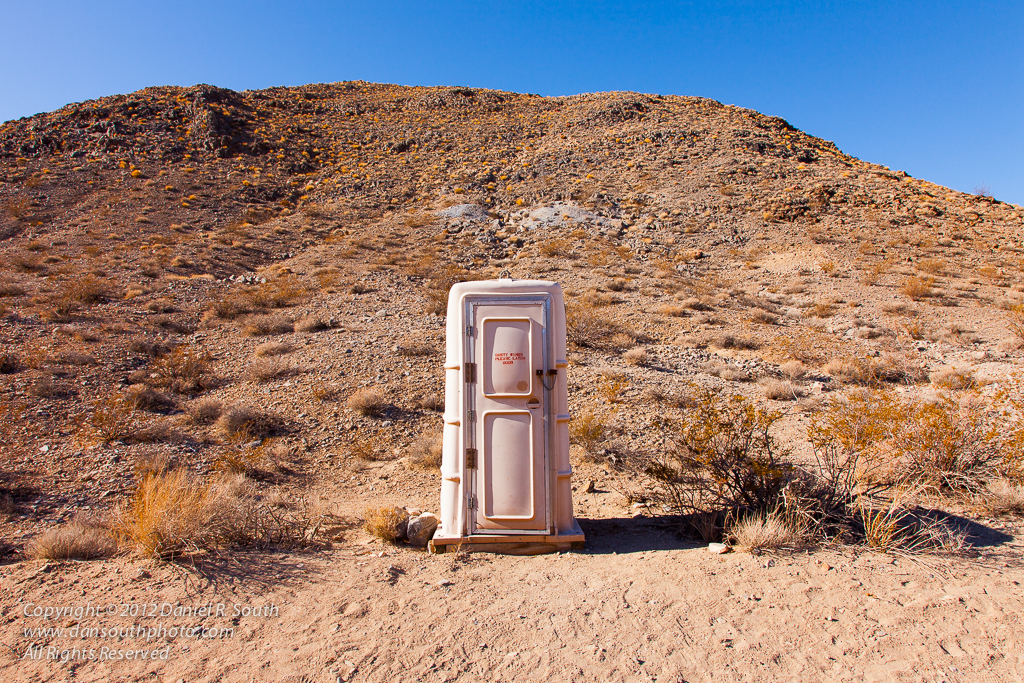
There are no comfort facilities at the Racetrack, but there's a campsite a few miles down the road.  There, you'll find a lone portable toilet which I've fondly nicknamed 'The Outhouse of Last Resort'.  You would be well advised to bring along your own supply of toilet paper and hand sanitizer.

a photo of an outhouse in death valley
The Outhouse of Last Resort


If everything goes well you can enjoy one of the world's great mysteries, grab a number of memorable shots, and look forward to another long drive on washboard roads, all in a day's adventure.


a photograph of a brilliant sunset at the racetrack in death valley
Racetrack Playa at Sunset, Death Valley National Park


Camera:
        Canon EOS 5D Mark II

Lenses:
        Canon 24-105 f/4L IS
        Canon TS-E24 f/3.5L II


Light happens.  Be ready.  Shoot hard.

Copyright © 2012 Daniel R. South
All Rights Reserved

Thursday, August 16, 2012

Death Valley National Park

Some Like It Hot

An advertising consultant might suggest that Death Valley has a branding problem.  That name doesn't sound particularly welcoming.  It doesn't suggest a land of unique and surprising beauty.  And it certainly doesn't sound like much of a vacation destination.

Luckily, labels aren't always accurate.  Scorching summer temperatures notwithstanding, Death Valley National Park is a magnificent and incomparable natural wonder.

Let's explore some of the park's diverse attractions.


Salt Flats near Badwater Basin

Death Valley once contained a lake.  Over time, large mountain ranges were forced upward in the west separating the lake from ocean moisture.  Moisture precipitated onto the towering mountains.  By the time that clouds reached Death Valley, most of their water supply had been exhausted.  The lake eventually dried up, but it left behind an abundance of salts and minerals.

We can still see these salt deposits today.  Surrounded by mountains these 'salt flats' can be visually stunning under the right conditions.

This photo was taken just after dawn as sunlight began to hit the Panamint Mountains to the west.


a photograph of the Badwater Basin Salt Flats at Sunrise in Death Valley
Salt Flats at Sunrise near Badwater Basin, Death Valley

Sunrise at Zabriskie Point

Zabriskie Point is the park's most popular place to watch the sunrise.  The dawning sunlight moves over a complex configuration of badlands and projects an inspiring array of colors and shadows.  Here, a feature known as Manley's Beacon is bathed in the fresh glow of a new day.

a photo of manley's beacon from zabriskie point at sunrise in death valley
Daylight Strikes Manley's Beacon, Zabriskie Point


Natural Diversity

Death Valley is a diverse landscape featuring rugged mountains, wind-swept dunes, and sprawling lava flows.


a photograph of lava flows at death valley national park
Lava Flows, Death Valley National Park

a photograph of the Mesquite Sand Dunes in Death Valley
Mesquite Sand Dunes near Stovepipe Wells, Death Valley


Scotty's Castle

A more unlikely pair would be difficult to imagine.  Wealthy, mild-mannered insurance businessman Albert Johnson befriended entertainer, cowboy, and eccentric story-teller Walter Scott, also known as 'Death Valley Scotty'.  Together the two spent decades building a sprawling vacation residence in Grapevine Canyon at the northern end of Death Valley.

Johnson's money financed the project although 'Scotty' convinced anyone who would listen that the mansion had been funded by his own secret gold mine.

a photo of scotty's castle in death valley national park
Scotty's Castle

The Racetrack

Beyond Grapevine Canyon and the volcanic Ubehebe Crater lies the entrance to an old mining road.  The road has a punishing washboard surface and it not suitable for passenger cars.  If you have a good back, a strong constitution, and a four-wheel-drive vehicle with heavy-duty tires, you can follow this road to one of Planet Earth's most peculiar mysteries - the moving rocks of Racetrack Playa.

No one has ever seen the rocks move, and no one is absolutely sure how it happens, but the rocks move along the clay-like surface (with some help from wind and rain) and leave trails to show the path of their movements.  It is a marvelously fascinating phenomenon.


a photograph of sliding rocks on the racetrack playa in death valley at sunrise
Intersecting Paths, Racetrack Playa

For the photo of the sliding rocks above I began a jolting two-and-a-half hour Jeep ride at 3:30 in the morning, wandered around in darkness looking for the composition, set up and executed the shot in freezing 27-degree (F) weather.  My hands were so numb by the time that I'd finished that I couldn't disassemble the tripod.

But it was worth it.  ;-)

I hope that you have enjoyed these images from Death Valley.  I'll be posting others in the near future, so please feel free to visit again soon.

I'll leave you with one last image, and we'll return to Zabriskie Point for a brilliantly colorful sunset.  This is one of my favorite photos of all time.


a photography of zabriskie point in death valley at sunset
Sunset Over Zabriskie Point, Death Valley National Park

Camera:
        Canon EOS 5D Mark II

Lenses:
        Canon 16-35 f/2.8L II
        Canon 24-105 f/4L IS
        Canon TS-E24 f/3.5L II
        Canon 70-200 f/4L IS


Light happens.  Be ready.  Shoot hard.

Copyright © 2012 Daniel R. South
All Rights Reserved